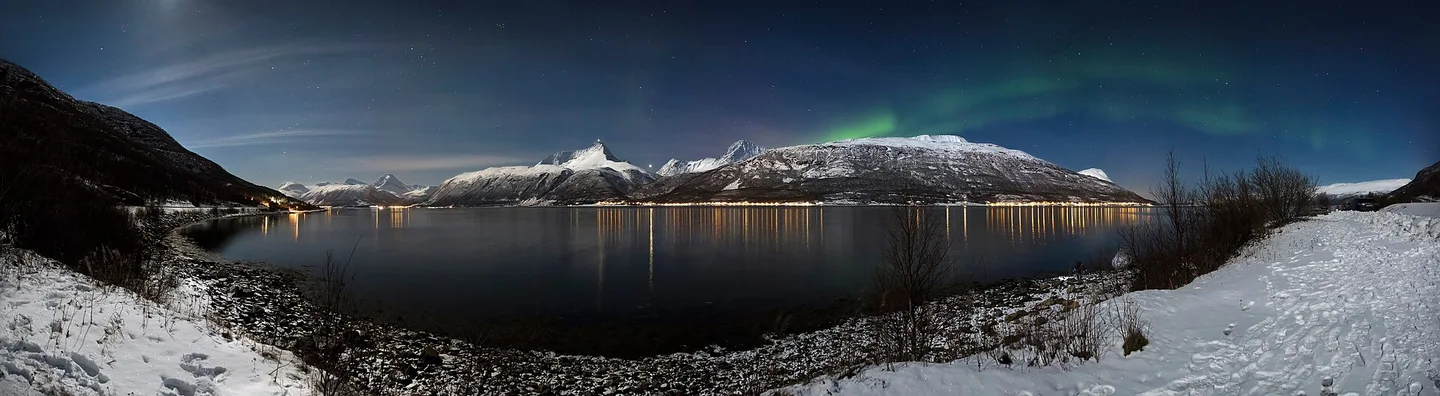
The aurora is a visible sign of energy passing from near-Earth space into the upper atmosphere, where excited atoms and molecules release light.
Energy from the Sun
The Sun releases a continual flow of charged particles known as the solar wind. Earth’s magnetic field shapes how particles and energy move around the planet.
During disturbed space-weather conditions, energy can be transferred into the near-Earth environment and accelerate particles toward high-latitude upper-atmosphere regions.
Why the colors differ
Fast-moving electrons collide with atmospheric oxygen and nitrogen, transferring energy to those atoms and molecules. As the excited states relax, they emit light at characteristic wavelengths.
Green emission from atomic oxygen is especially familiar. Red oxygen emissions and blue or purple contributions from nitrogen can also appear, depending on altitude and conditions.
Curtains in motion
Auroral shapes follow the geometry of Earth’s magnetic field and changes in the incoming particle populations. The glowing forms can stretch, fold and brighten over short intervals.
Although auroras are mostly associated with polar regions, strong geomagnetic storms can make them visible at lower latitudes.