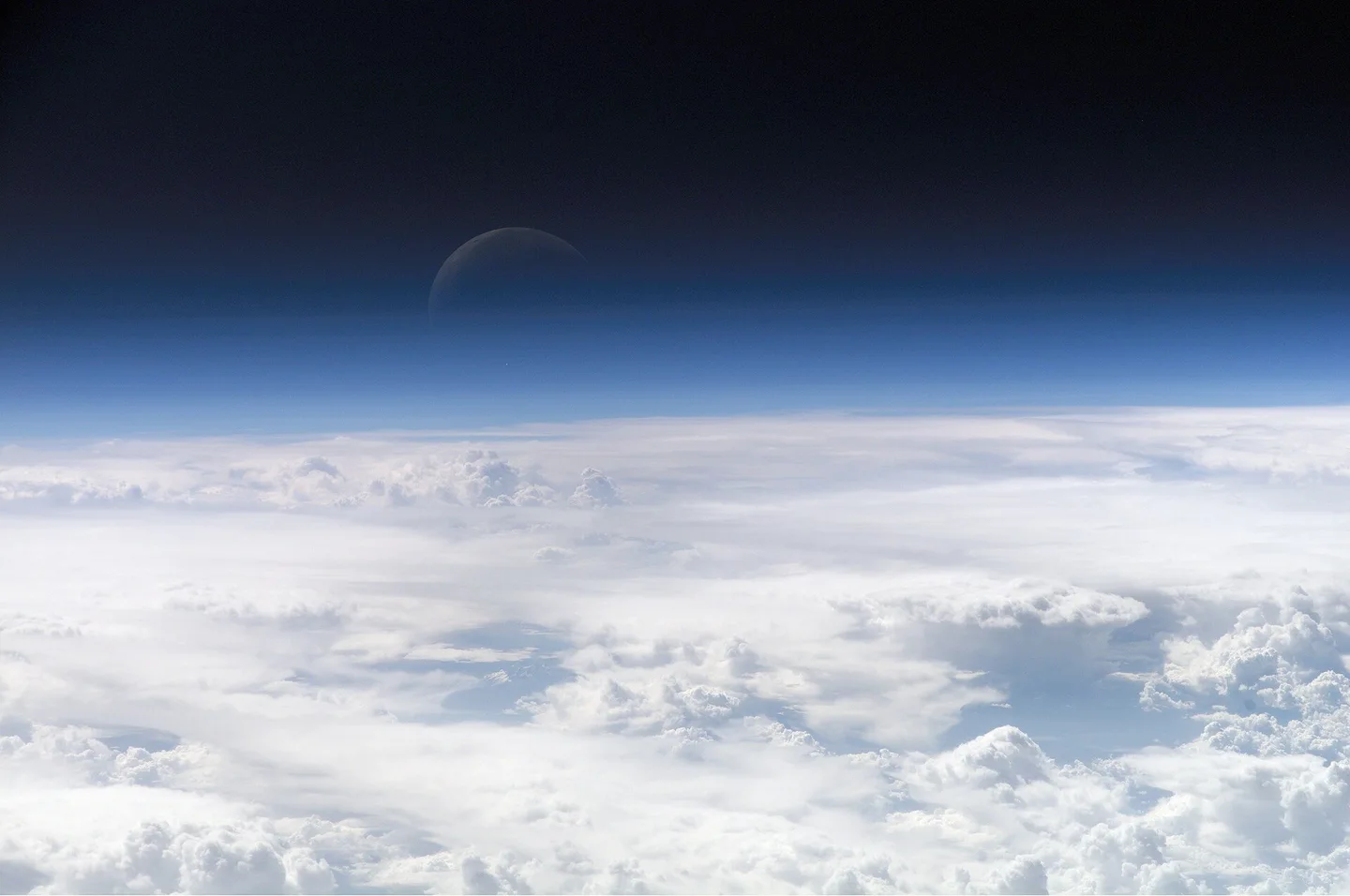
Earth’s atmosphere is usually described as five major layers. Each is distinguished chiefly by how temperature changes with altitude, rather than by a hard physical wall.
The weather-making troposphere
The troposphere begins at the surface and contains most weather phenomena and much of the atmosphere’s mass. Its upper boundary changes with latitude, season and weather patterns.
Above it lies the stratosphere, where the ozone layer absorbs ultraviolet radiation. Temperature generally increases with height in much of this layer.
The middle and upper atmosphere
The mesosphere extends above the stratosphere; temperatures decrease upward and can become extremely cold near the mesopause.
In the thermosphere, absorption of high-energy solar radiation produces a strong increase in kinetic temperature. Its air is nevertheless so thin that ordinary experiences of warmth do not apply.
Where does space begin?
The exosphere is a very tenuous outer region that gradually merges with interplanetary space. Unlike a solid surface, the upper atmosphere has no universally sharp final edge.
The ionosphere is a region of electrically charged particles that overlaps multiple altitude layers rather than a separate sixth temperature-defined layer.