Beyond
the blue.
Earth’s atmosphere has no hard ceiling. Travel upward through changing temperature, density and chemistry.
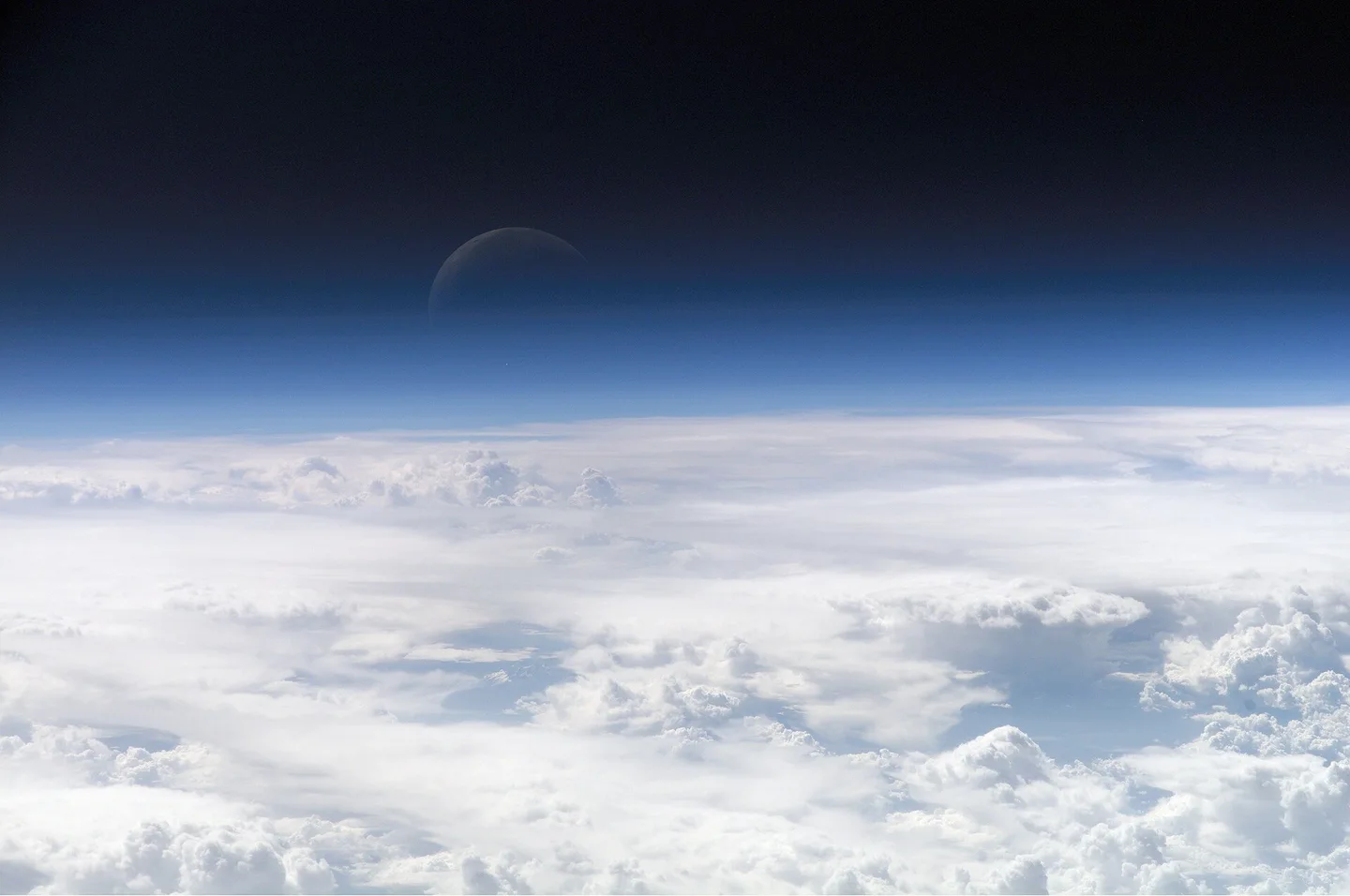
Troposphere
- Approximate altitude
- Surface–~12 km
- Temperature trend
- Generally decreases with height
The familiar sky: clouds, precipitation and most everyday weather. Its upper boundary varies with latitude, season and weather.
Stratosphere
- Approximate altitude
- ~12–50 km
- Temperature trend
- Generally increases with height
Above most weather, ozone absorbs ultraviolet radiation. This absorption helps explain the temperature increase with altitude.
Mesosphere
- Approximate altitude
- ~50–85 km
- Temperature trend
- Decreases toward the mesopause
Temperatures fall again above the stratosphere. Many meteors ablate here, and noctilucent clouds occur near its upper reaches.
Thermosphere
- Approximate altitude
- ~85–600 km
- Temperature trend
- Increases; strongly variable
Very thin gases absorb high-energy solar radiation. Much auroral activity occurs here; particle temperature is different from the warmth we feel at the surface.
Exosphere
- Approximate altitude
- ~600 km and beyond
- Temperature trend
- Particle energies; very sparse gas
The outer atmosphere becomes exceptionally tenuous and gradually merges into the surrounding space environment. There is no sharply defined final edge.
A visual teaching model, not a live simulation. Layer thicknesses and the Earth-to-atmosphere ratio are deliberately expanded. The outer atmosphere fades gradually into space.
One atmosphere.
Five perspectives.
Boundaries are approximate. They vary with latitude, season, solar activity and the definition being used.
| Layer | Altitude | Temperature | What distinguishes it |
|---|---|---|---|
| Troposphere | Surface–~12 km | Generally decreases with height | The familiar sky: clouds, precipitation and most everyday weather. Its upper boundary varies with latitude, season and weather. |
| Stratosphere | ~12–50 km | Generally increases with height | Above most weather, ozone absorbs ultraviolet radiation. This absorption helps explain the temperature increase with altitude. |
| Mesosphere | ~50–85 km | Decreases toward the mesopause | Temperatures fall again above the stratosphere. Many meteors ablate here, and noctilucent clouds occur near its upper reaches. |
| Thermosphere | ~85–600 km | Increases; strongly variable | Very thin gases absorb high-energy solar radiation. Much auroral activity occurs here; particle temperature is different from the warmth we feel at the surface. |
| Exosphere | ~600 km and beyond | Particle energies; very sparse gas | The outer atmosphere becomes exceptionally tenuous and gradually merges into the surrounding space environment. There is no sharply defined final edge. |