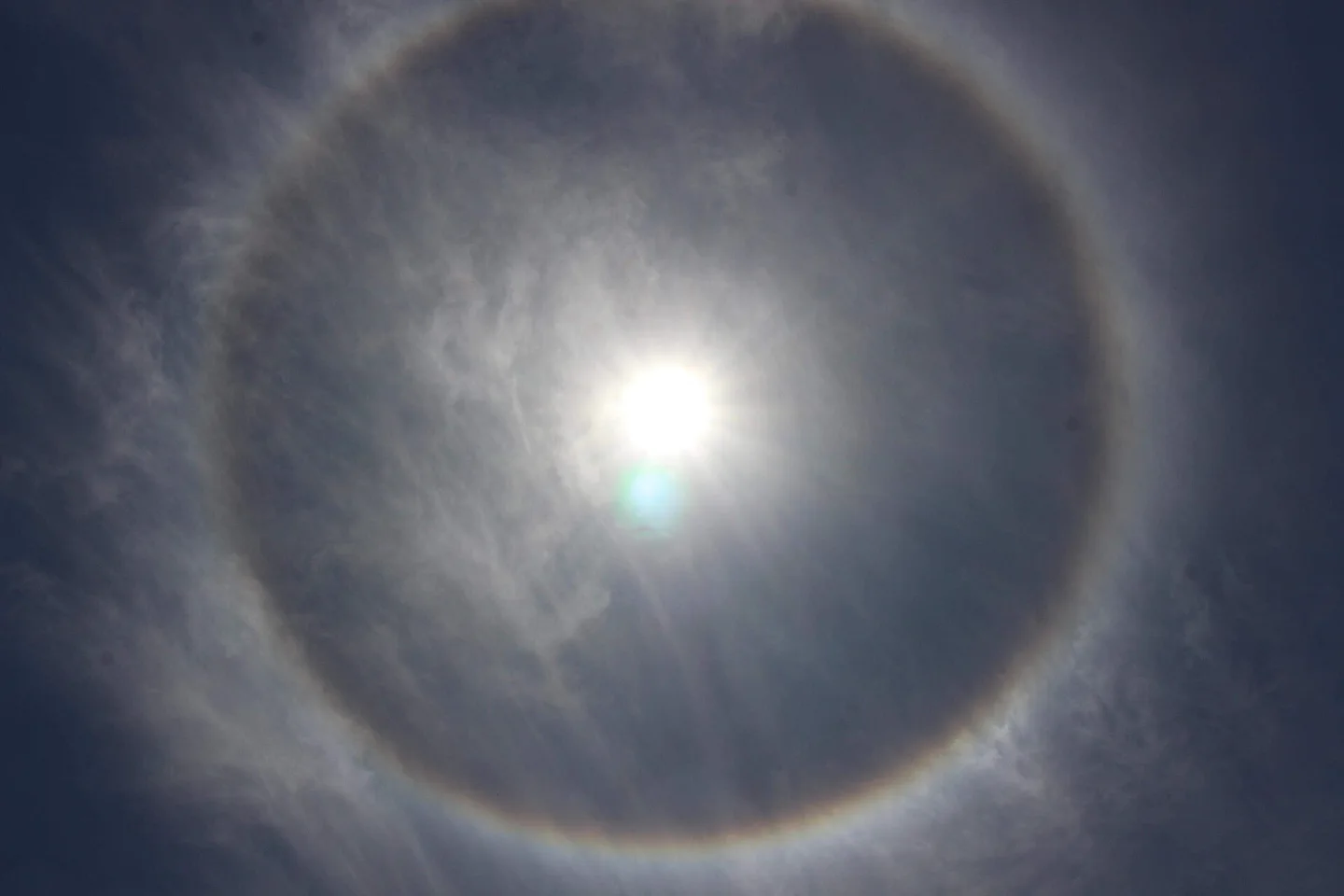
A pale ring around the Sun or Moon may look mysterious, but its geometry is a clue to the ice crystals that refract light high overhead.
A sky full of prisms
Many halos occur when light passes through hexagonal ice crystals found in high clouds such as cirrostratus. Refraction bends the light, while reflections within or from crystals produce other optical forms.
A common circular halo appears at an angular distance of about 22 degrees from the Sun or Moon. Its visibility depends on crystal shape, orientation and the amount of ice cloud.
Arcs, pillars and bright spots
Not all atmospheric optical effects are complete rings. Favorably oriented crystals can produce bright sundogs, arcs or vertical pillars of light.
The position of the Sun, the crystals’ orientation and their size determine which effect becomes visible.
Observation without risk
A camera, a building shadow or a careful glance away from the solar disk can help reveal a halo. Never look directly at the Sun through optical equipment without appropriate solar protection.
High cloud associated with halos can sometimes precede changing weather, but a halo by itself is not a reliable short-term forecast.